(1).png "Anchor Fasteners")
Screws

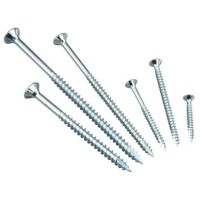
A screw is an inclined plane wrapped around a nail. Some screw threads are designed to mate with a complementary thread, known as a female thread (internal thread), often in the form of a nut or an object that has the internal thread formed into it. Other screw threads are designed to cut a helical groove in a softer material as the screw is inserted. The most common uses of screws are to hold objects together and to position objects.
A screw will usually have a head on one end that contains a specially formed shape that allows it to be turned, or driven, with a tool. Common tools for driving screws include screwdrivers and wrenches. The head is usually larger than the body of the screw, which keeps the screw from being driven deeper than the length of the screw and to provide a bearing surface. There are exceptions; for instance, carriage bolts have a domed head that is not designed to be driven; set screws often have a head smaller than the outer diameter of the screw; J-bolts have a J-shaped head which is not designed to be driven, but rather is usually sunk into concrete allowing it to be used as an anchor bolt. The cylindrical portion of the screw from the underside of the head to the tip is known as the shank; it may be fully threaded or partially threaded.[1] The distance between each thread is called the "pitch".
The majority of screws are tightened by clockwise rotation, which is termed a right-hand thread; a common mnemonic device for remembering this when working with screws or bolts is "righty-tighty, lefty-loosey." Another rule is this: curl the fingers of your right hand around the screw with your thumb pointing is the direction you want the screw to go. If the screw is right-handed (most screws are) and you turn the screw in the direction of your fingers the screw will move in the direction of your thumb. Screws with left-hand threads are used in exceptional cases. For example, when the screw will be subject to counterclockwise torque (which would work to undo a right-hand thread), a left-hand-threaded screw would be an appropriate choice. The right side pedal of a bicycle has a left-hand thread.
More generally, screw may mean any helical device, such as a clamp, a micrometer, a ship's propeller or an Archimedes' screw water pump.
Refine Search